We asked Falkland veterans to share their memories with us. This is The Falkland’s War, a Signallers Story by Andrew Turner
Some of you may be aware that the Falklands war was 40 years ago and is being commemorated in many places across the country throughout April - June which is the period this took place. Why am I writing about this now, well because I was there and whilst every year I remember those no longer with us, I felt that as its been so long I ought to record something to pass on to others. This is not about heroics or celebrating war (who does!) but just a recollection of what life was like as a 20 something year old serving in the Royal Signals.
I joined as a junior soldier, training as a Radio Telegraphist. This resulted in me learning Morse, typing as well as everything involved in operating VHF and HF radios to send messages over a distance of between 5 and 200+ miles. I was posted to my first unit which was 5 Infantry Brigade Signal Squadron. I worked in various roles which utilised these skills and especially in the Falklands.
So, it was nearly Easter in 1982, a Friday afternoon and we were all looking forward to a weekend ‘off duty’ when we were told to parade as something was happening. We had heard that the Argentinians had invaded the Falklands, we asked what they were doing off the coast of Scotland! Having heard the news broadcasts, the penny immediately dropped and we knew what the parade would be about. So briefing completed we began collecting or buying equipment, to this day I still have my bergen I bought as I knew the issued large pack would not be big enough, it saw use on many scout camps, I also still have the clear plastic welding goggles in their wrapper, these were issued to protect me from snow blindness.
Our vehicle and radio set up was for in peacetime, installed in 4-ton lorries which were way too big to move when in the Falklands. So, we collected brand new Landrovers which we converted before and during our pre-deployment training in Sennybridge. Between shifts we fitted hardtops and even painted the Landrovers, we also installed Norwegian heaters which turned out to be useless as you could not use them when static.
Each detachment was three operators and a Landrover which had a HF Radio running off four large lorry type batteries with two teleprinters, all mounted in the back of the vehicle. We had to tow a ¾ ton trailer with two massive generators and six cans of fuel along with radio masts and other communications kit. A few vehicles also had a 9x9 tent which linked to the back of the Landrovers when set up, others had a 20x20 tarpaulin that was stretched over the back and pegged out. The tent/tarpaulin housed a table for a printer and secure communications equipment and for the lucky few a kerosine heater. For our ‘accommodation’ there was a basha somewhere near the vehicle so that you were always available for your next shift or to go on sentry duty. All this was then covered in a 40x40 camouflage net, which with its poles were strapped to the roof when mobile!
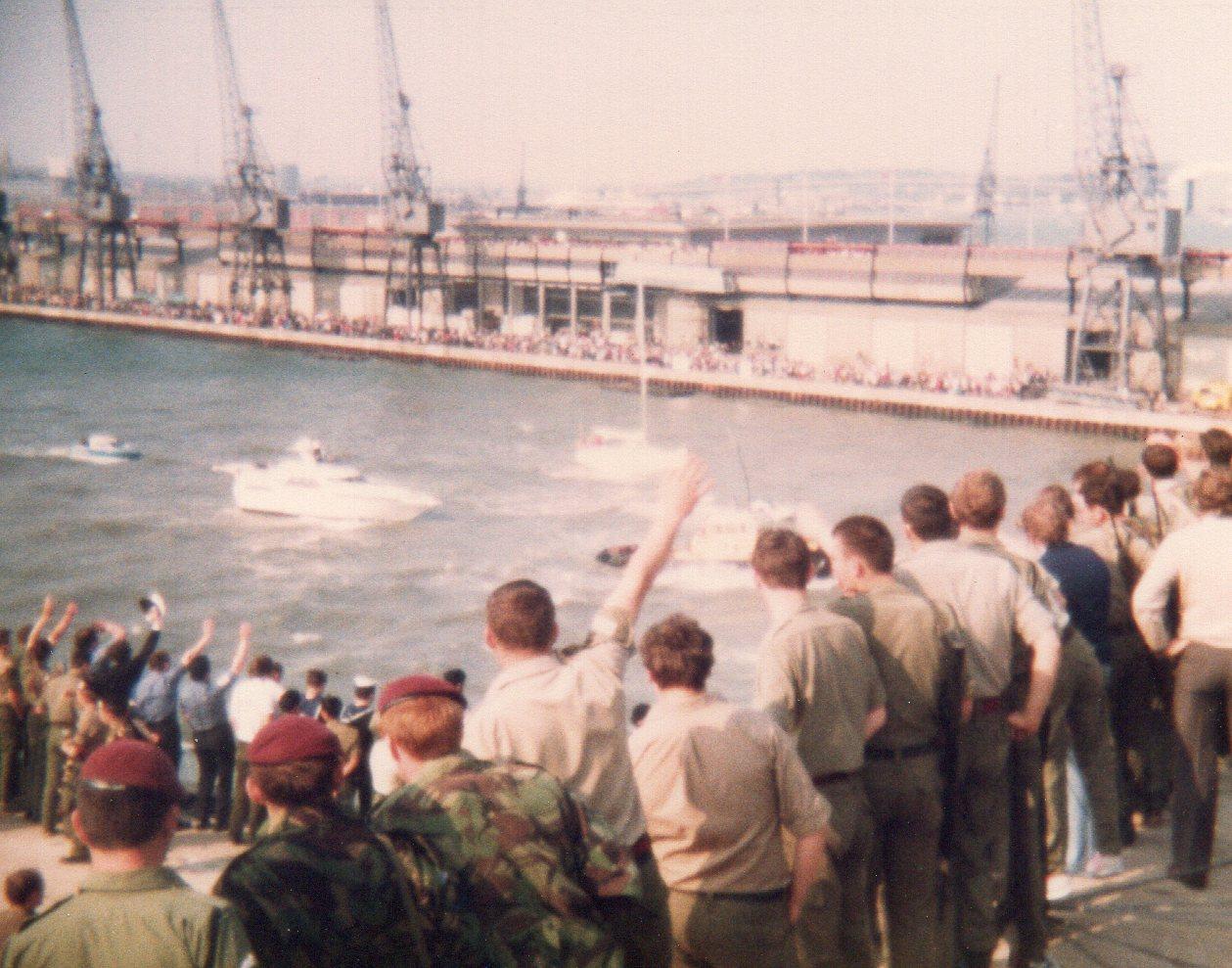
Sailing out of Southampton
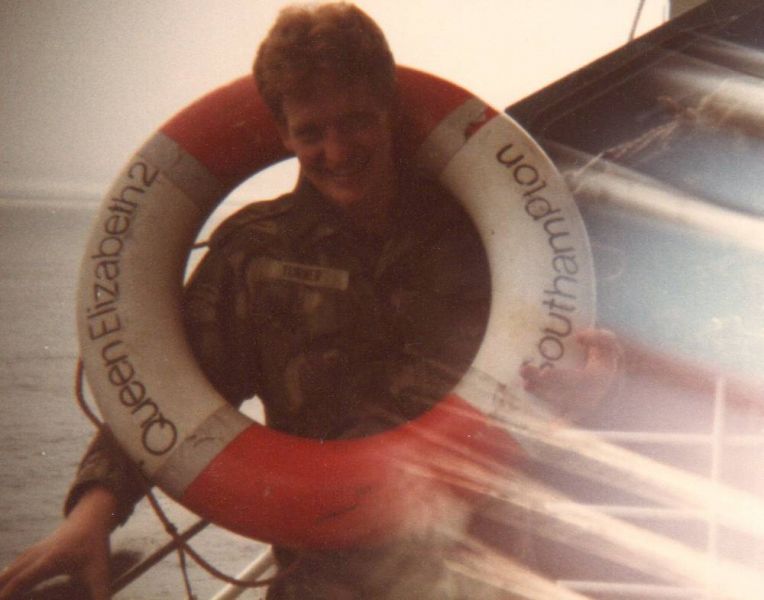
So, after a long weekend leave to see our families, we sailed on the QE2 to South Georgia via Freetown, Sierra Leone and the Ascension Islands. In South Georgia we transferred to the Canberra to sail into San Carlos, thankfully this was an uncontested landing unlike the first one. When we deployed forward from San Carlos it took three attempts for a Sea King helicopter to lift one of our Landrovers as this was too heavy, we had to offload the cam net and poles and our personal kit onto the trailers before they could lift a Landrover. Due to the loss of helicopters as a result of the sinking of the Atlantic Conveyer, it was some time before we had all our detachments ashore and in fact some didn’t land until after the war. We deployed forward to Goose Green, initially I was part of the HQ Guard, watching inlets for sea landings or as a sentry outside buildings used by the 5 Infantry Brigade Headquarters. During this time, we lost our Commanding Officer and a Troop Staff Sergeant along with the crew of a Gazelle Helicopter, shot down whilst replenishing one of the Squadron rebroadcast detachments.
We still meet in May each year to remember them along with the other 254 who paid the price. Not long after this we moved forward to Fitzroy, on the day the Galahad was hit. This really brought home the reality of where we were and I found out how little practical first aid I knew. A real lesson learnt here and something the army made sure would not be an issue again as they initiated formal annual training for every soldier thereafter.
After what seemed like ages, but was only days, I was back operating on a secure teleprinter detachment to send what most would understand as telex messages. This meant being on a radio network with detachments at 3 Commando Brigade and General Moore’s HQ. Due to the fact that in our peacetime role we did not have the latest equipment, there were problems working on the network. We had to use what is known as Single Side Band (SSB) rather than suppressed SSB like the 3 Commando Brigade and the main HQ. As a result, we would knock their signal out as we could not hear them transmitting. We were therefore not popular on the network as a signal could take minutes to transmit, unlike the immediacy of email today, and you had to then wait for confirmation it had been received. Imagine how frustrating it would be to have to start a message again. The messages were on paper tape which had to be kept dry and we were working in such cold temperatures, remember the lack of kerosine heaters and in fact no fuel for them, we had to burn paper in our tent to keep our hands warm for typing as you couldn’t do this wearing gloves.
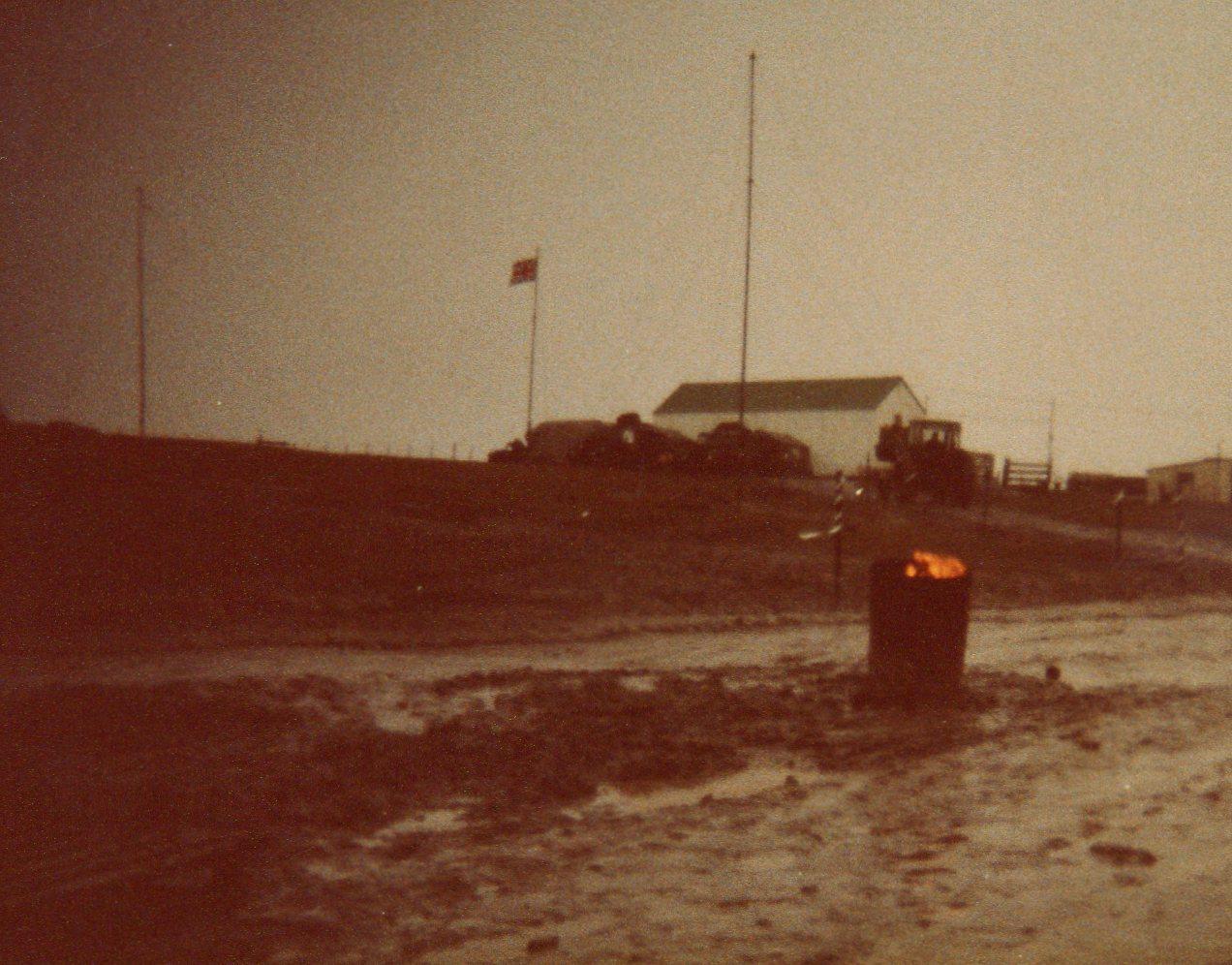
Our detachment at Fitzroy, I still have the Union Flag that is flying on the radio mast
We remained in Fitzroy until the end of the war. For once we drove our Landrovers onto Mexifloats, which is a motorised pontoon, to transfer to a Navy logistics ship, had our first shower since leaving Canberra which was such luxury. Overnight we sailed round to Stanley Harbour and a few of us cross decked the Landrovers onto a merchant ship. This was in the middle of the harbour down a ramp, onto a mexifloat and up onto the merchant ships ramp, quite an experience and something health and safety today would challenge. Just a few of us joined the merchant ship to sail down to South Georgia to pick up the marines who had captured the island. We then sailed all the way back to the UK having dropped the Marines off at Ascension Island so they could fly home. As I recall not long after leaving Ascension we lost an engine and so limped home, it was a very slow journey from there. In all we were at sea for about a month getting back to Southampton at the end of July to be greeted by our families, home safe and sound. I personally am thankful to have been part of such an operation and take stock of this every day, thankful that I came back, mindful of those that didn’t or who are still suffering today.
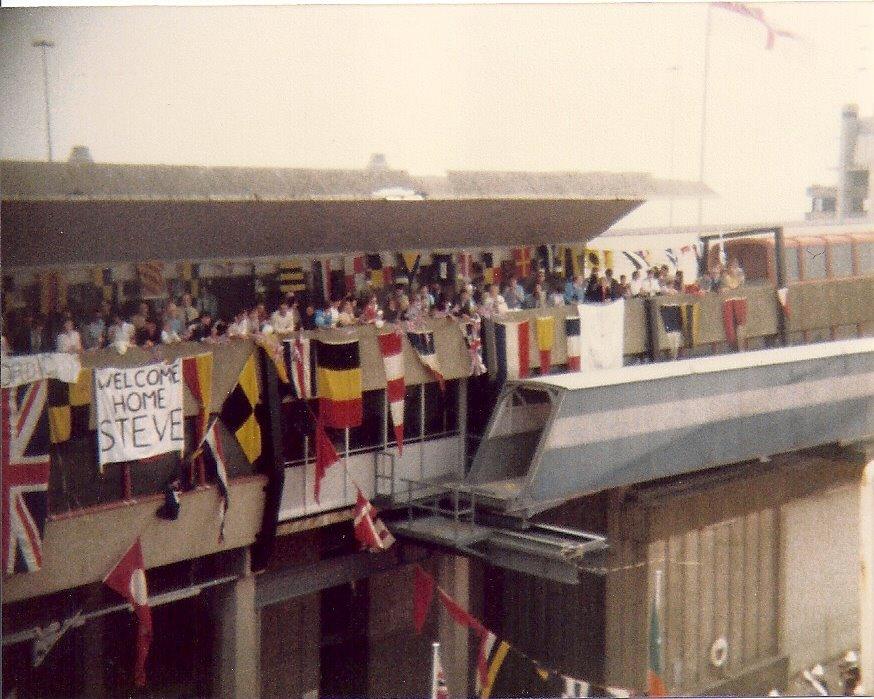
Welcome Home, my family is just above the end of the gangway
Thank you for reading.